
7 people who advanced artificial intelligence the most
Today’s LLMs look as if they fell from the sky sometime in November 2022. In reality they stand on ninety years of work — and a surprisingly large part of it was done by a handful of specific people. We have chosen seven figures whose discoveries form a continuous thread from the question “what is computation anyway” to a model that predicted the structure of 200 million proteins. For each we show exactly what they achieved, why it was a technical breakthrough, and how the next ones built on it. It won’t be just a list of names and dates — we want to understand why these things work.
Why these seven
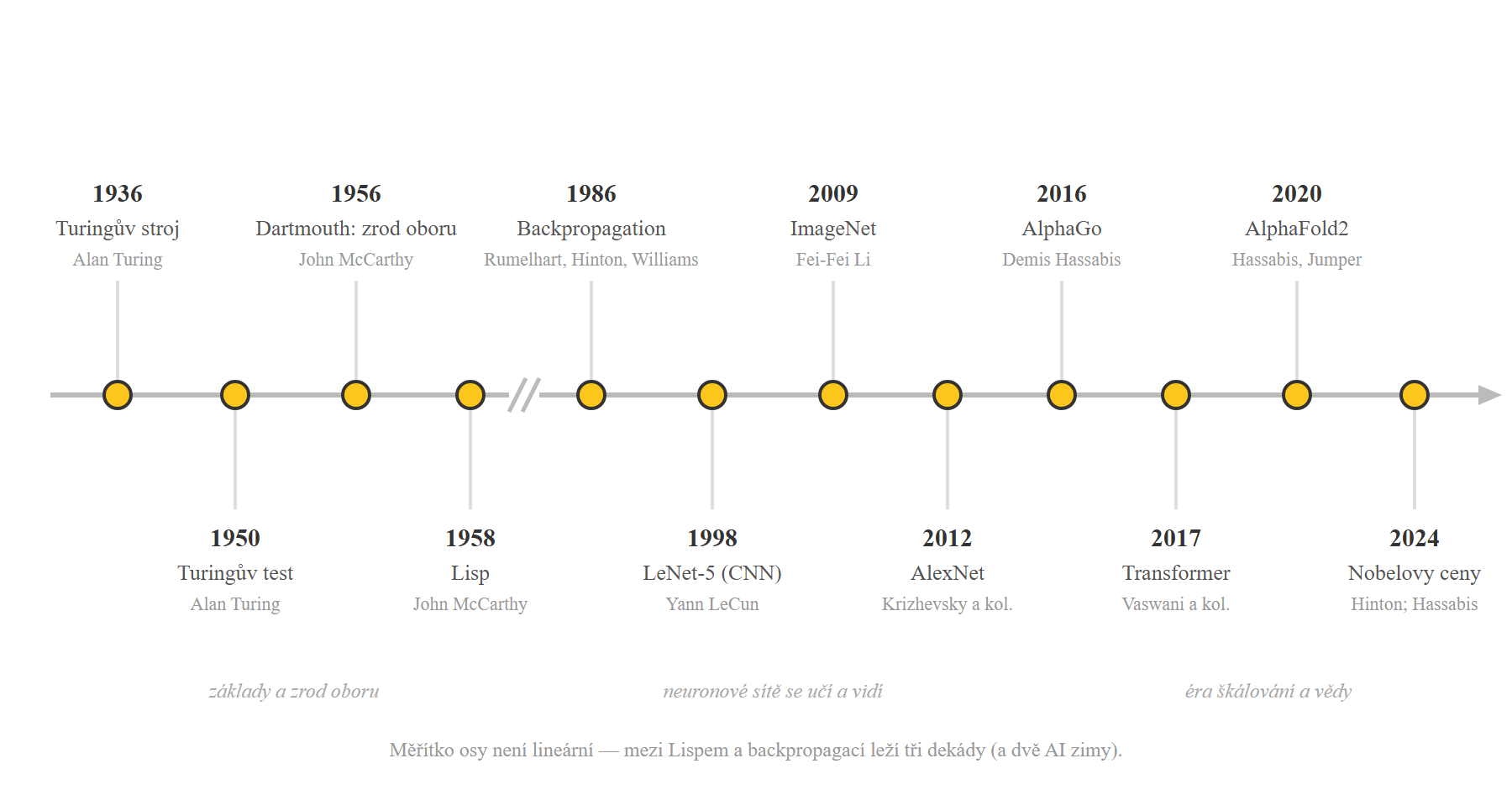
Any list like this is necessarily unfair, so let’s be upfront: the criterion was neither citation count nor famous names, but continuity. We wanted seven stops that together tell one story: theoretical foundations (Turing) → founding of the field (McCarthy) → the learning algorithm (Hinton) → an architecture with suitable priors (LeCun) → data as the third pillar (Fei-Fei Li) → a scalable architecture (Vaswani and the Transformer team) → deployment on real scientific problems (Hassabis).
And whom did we leave out? Above all Yoshua Bengio — there are three “godfathers of deep learning” and he received the 2018 Turing Award together with Hinton and LeCun; we also owe his group the attention mechanism, which we’ll get to with the Transformer. He doesn’t have his own chapter only because it would overlap in content with Hinton and LeCun. Then Ilya Sutskever (co-author of AlexNet, seq2seq and the main scientific force behind the GPT models), Frank Rosenblatt with the perceptron from 1958, Marvin Minsky, Claude Shannon, John von Neumann… And of course Jürgen Schmidhuber, whose lab gave the world LSTM — if we didn’t mention him, he would, as is his habit, remind us himself.
How to read this article
It is not a popularity ranking. Take it as a technical map: each person adds one missing layer to the story — computation, the field, learning, architecture, data, scaling and finally application in science.
1. Alan Turing — the man who defined computation (and asked whether machines think)
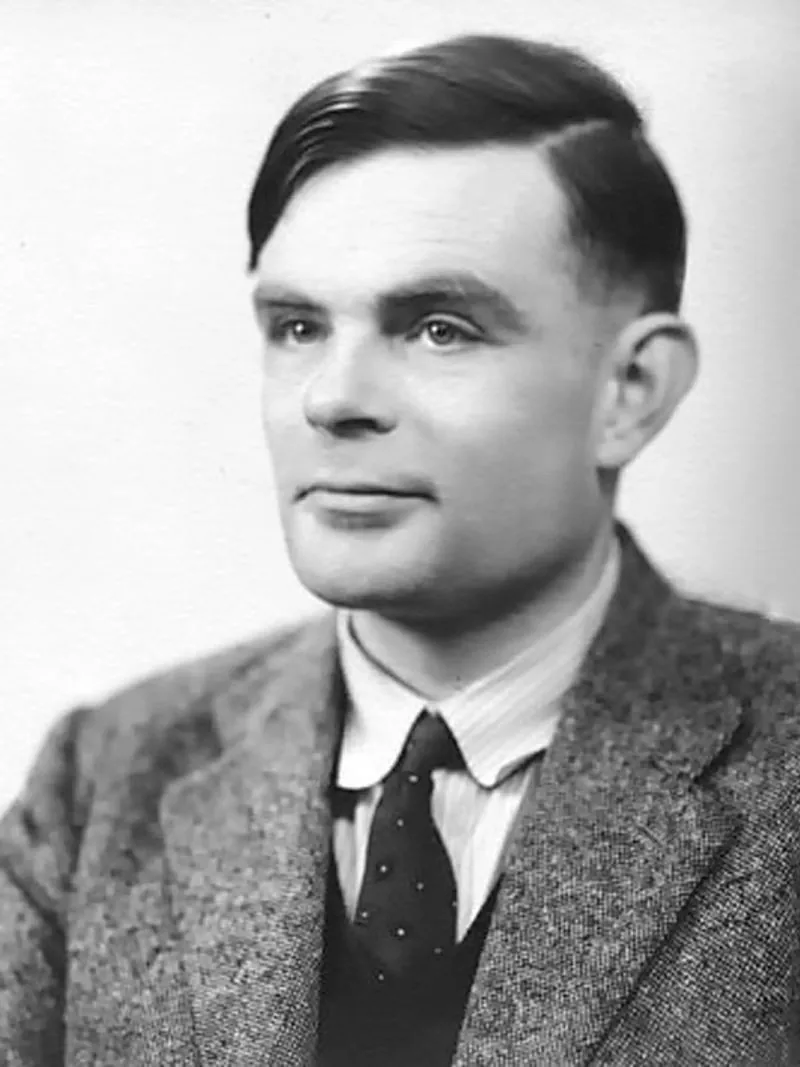
Everything we do in IT today rests on a paper written in 1936 by a twenty-four-year-old doctoral student at Cambridge. On Computable Numbers, with an Application to the Entscheidungsproblem addressed what at first sight was a purely mathematical question of David Hilbert’s: is there a mechanical procedure that decides, for any mathematical statement, whether it is provable? To answer it (in the negative), Turing first had to formally define what a “mechanical procedure” means. The result is the Turing machine: an infinite tape, a read head and a finite table of rules.
Two consequences are fundamental. First, universality: Turing showed that there is one specific machine that can simulate any other Turing machine if it receives its description on the tape as data. A program is thus just another input — the idea from which, a decade later, the von Neumann architecture grew, and with it every computer you are reading this article on. Second, the limits of computability: there are well-defined problems (the halting problem) that no algorithm can solve. Computer science thus came into being before computers — including its limits.
For AI, though, Turing’s second famous text is equally important. In 1950 he published in the journal Mind the essay Computing Machinery and Intelligence, which opens with the sentence “I propose to consider the question: Can machines think?” Because the question is ill-defined, Turing replaced it with an operational test — the imitation game, today known as the Turing test: if a judge in a text conversation cannot tell the machine from a human, there is no point in denying the machine thought. We can debate the usefulness of the test (today’s LLMs pass it in some studies and yet hallucinate), but as a reframing it was brilliant: he turned a metaphysical question into an empirical one.
And one more thing that is often overlooked: at the end of the same essay Turing suggests that instead of programming an adult mind it will be easier to build a child machine — a simpler machine that learns the rest itself from data and experience. In 1950, thirty-six years before backpropagation, he thus sketched the basic thesis of machine learning. Turing died in 1954, two years after his conviction for homosexuality; the most prestigious award in computer science — the Turing Award, which the ACM has presented since 1966 — bears his name, and four people on this timeline receive it.
2. John McCarthy — gave the field its name and programmers Lisp
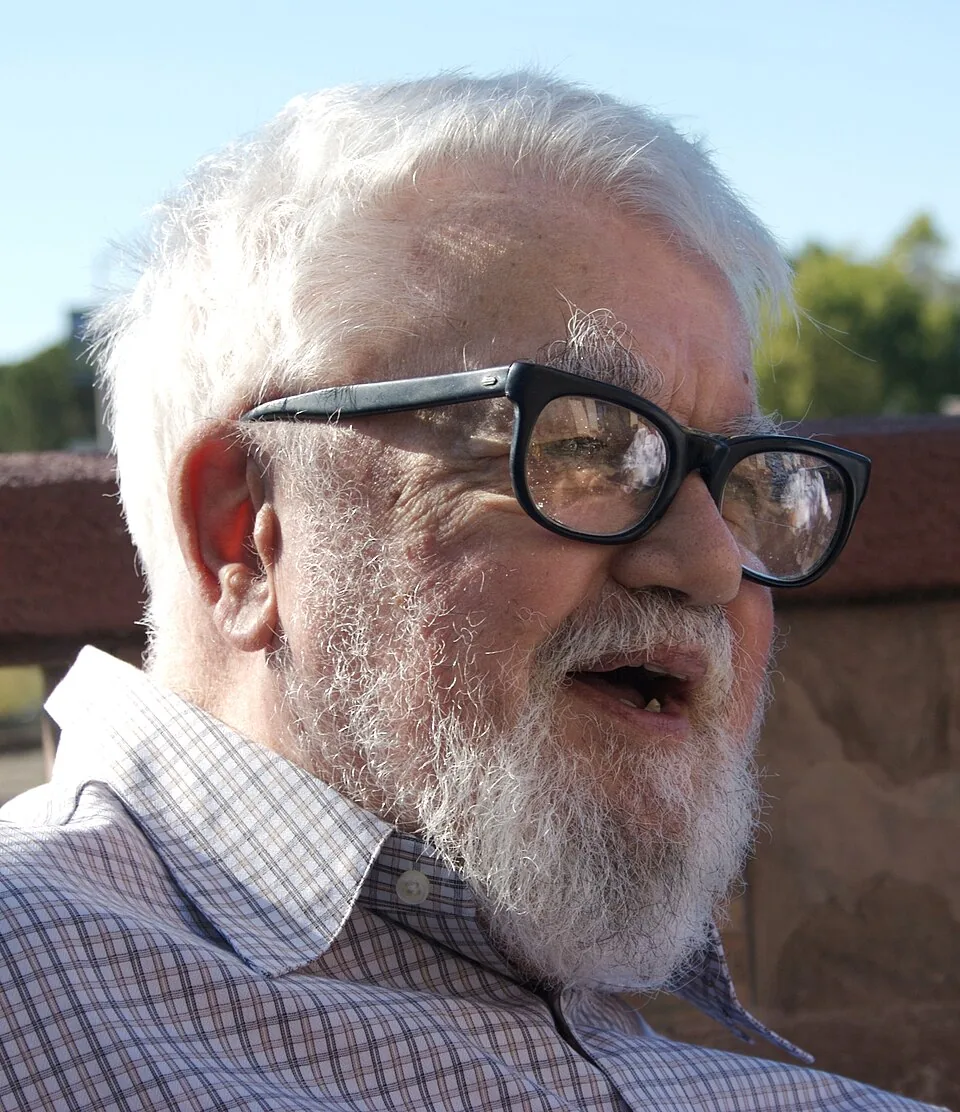
The term artificial intelligence was not born in a laboratory but in a grant application. In 1955 John McCarthy, together with Marvin Minsky, Nathaniel Rochester and Claude Shannon, wrote a proposal for a summer research project at Dartmouth, whose premise still hangs over the whole field: “every aspect of learning or any other feature of intelligence can in principle be so precisely described that a machine can be made to simulate it.” The workshop itself took place in the summer of 1956 and brought together most of the people who then shaped the field for two decades. McCarthy chose the name deliberately — he needed to distinguish the field from the cybernetics of the time (and from its dominant father Norbert Wiener). The marketing was excellent; the ambition of the proposal (“significant advance in one summer with ten people”) is something the field still struggles with today.
If McCarthy had only invented the name, he wouldn’t have made this selection. But in 1958 he designed Lisp — a language for symbolic computation that he needed for his Advice Taker program (reasoning over knowledge written in logic; an idea AI returns to in every generation, most recently with knowledge graphs for agents). Lisp is, after Fortran, the second-oldest high-level language still in use and it is hard to overstate what appeared in it first: garbage collection (McCarthy invented it because manual memory management with symbolic structures was unsustainable), conditional expressions, recursion as a basic building block, functions as first-class values, and above all homoiconicity — code is a data structure (a list), so a program can manipulate programs. The interactive REPL loop you have today in Python and in the browser is also a Lisp legacy.
McCarthy received the Turing Award in 1971, among other things for promoting time-sharing — the idea that an expensive computer should serve many people interactively and simultaneously. When you rent a GPU in the cloud today (or in our GPU Lab), you are using the economic model McCarthy advocated back in the sixties. His symbolic branch of AI — logic, planning, expert systems — hit a ceiling in the eighties and the AI winter came, but it didn’t disappear: today’s agents combine a neural model with explicit tools, planning and structured knowledge. What this looks like in practice is covered in the article What an AI agent is and how it works.
3. Geoffrey Hinton — forty years of betting on neural networks
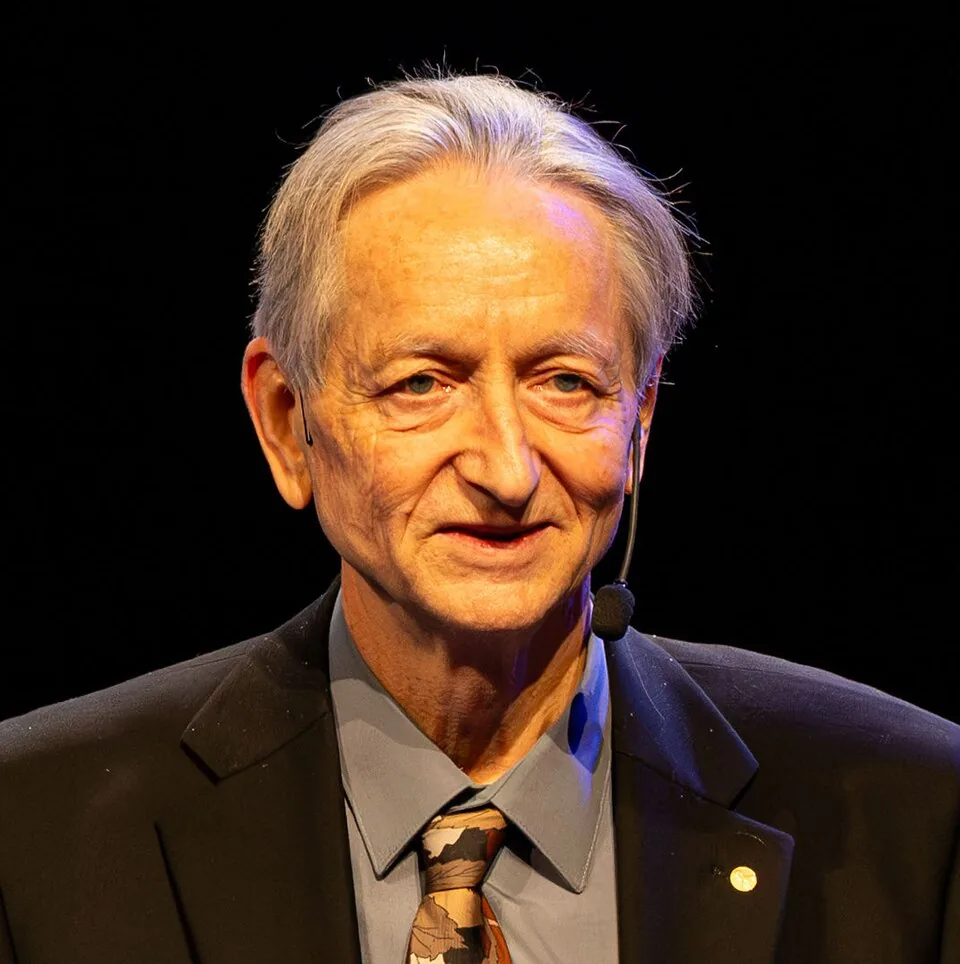
If this story has a main character, it is Geoffrey Hinton. A psychologist by training, he was fascinated by a single question: how does the brain learn? And he sought the answer at a time when neural networks were under an academic ban — Minsky and Papert in the book Perceptrons (1969) showed that a single-layer perceptron can’t even handle XOR, and funding dried up for two decades. The problem, though, was not in the concept but in learning: a multi-layer network can do XOR, but nobody knew how to set the weights of the hidden layers. Which neuron in the middle of the network should be credited for the error at the output?
The answer is backpropagation. The paper Learning representations by back-propagating errors (Rumelhart, Hinton, Williams, Nature 1986) described how to propagate the error from the output back through the network using the chain rule for derivatives: you compute the gradient of the loss function with respect to all the network’s weights in a single backward pass, i.e. at roughly the cost of one forward pass — instead of trying to change each weight separately. Learning thereby becomes gradient descent in a high-dimensional space. The algorithm itself was discovered several times independently (Linnainmaa 1970 as automatic differentiation, Werbos 1974 — this is the part where Schmidhuber is right), but only this paper showed what was really at stake: the network creates distributed representations in its hidden layers by itself — internal features nobody defined for it. This is exactly the mechanism thanks to which embedding vectors today capture the meaning of words (and vector databases work).
Another long winter followed — in the nineties SVMs were winning and neural networks were again on the margins. Hinton didn’t give up: in 2006 he and colleagues showed how to pre-train deep networks layer by layer using restricted Boltzmann machines, bringing the word deep back into play. And in 2012 came the moment when everything turned: Hinton’s doctoral students Alex Krizhevsky and Ilya Sutskever trained on two gaming GPUs the convolutional network AlexNet (60 million parameters, ReLU activations, dropout) and won the ImageNet competition with a top-5 error of 15.3% against 26.2% for second place. In a field where competitors fight over tenths of a percent, that was not a shift but a demolition — and within two years all of computer vision moved to deep learning.
Hinton’s story has an unusual ending. In 2013 he went to Google (which bought his three-person company DNNresearch), in 2019 he received, together with LeCun and Bengio, the 2018 Turing Award, in May 2023 he left Google so that he could speak freely about the risks of the technology he had spent his life building. And in October 2024 he received, together with John Hopfield, the Nobel Prize in Physics — formally for Boltzmann machines and the energy-based models of the eighties that connected neural network learning with statistical physics. Few people in the history of science have received the highest honours for work the mainstream rejected for thirty years.
4. Yann LeCun — convolution, or architecture is a prior
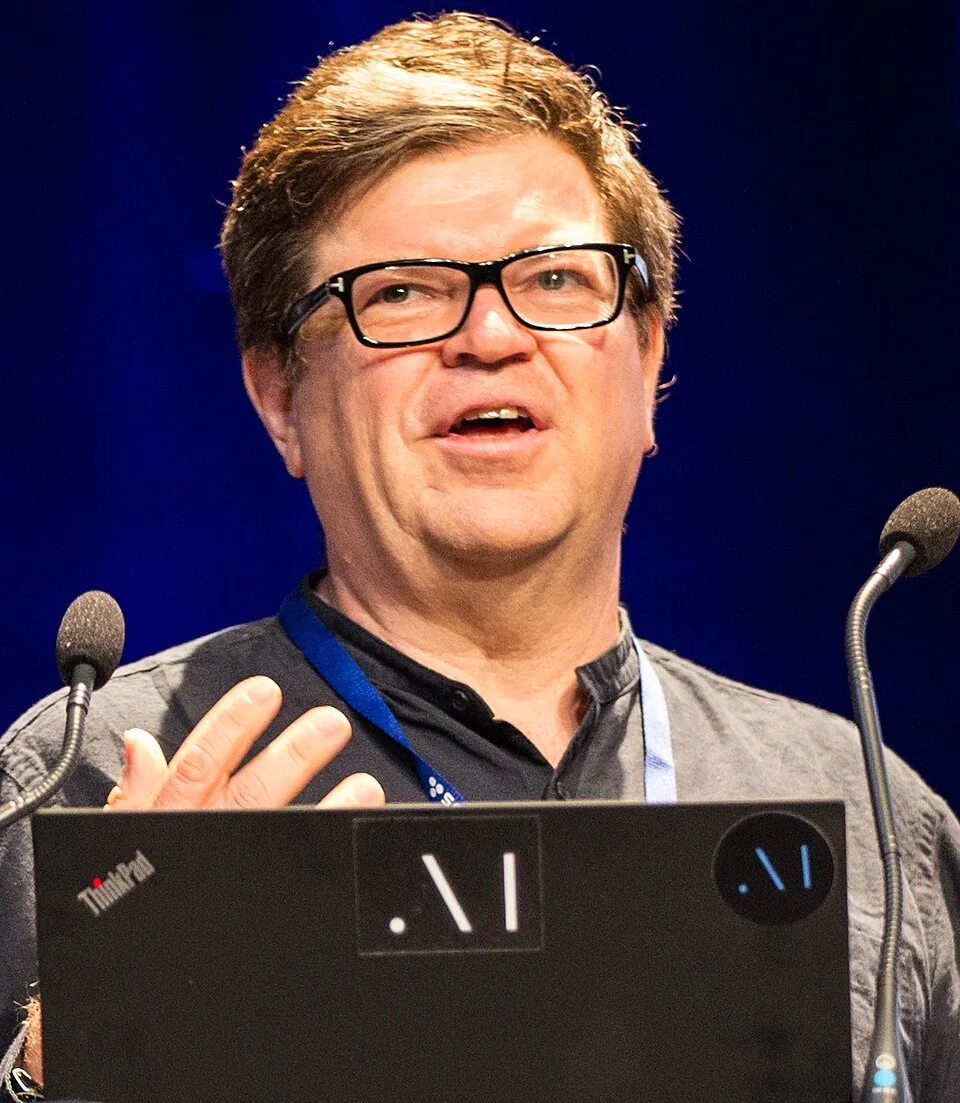
Backpropagation solves how to learn. Yann LeCun solved what should be learned — that is, what structure to give the network so that it learns efficiently. A fully connected network for images is nonsense: a 224×224 pixel image means 150 thousand inputs and the first layer would have billions of weights, all of which have to learn the same thing (you recognise an edge in the top left just as in the bottom right). LeCun, who did a postdoc in Hinton’s group, embodied two observations about images in the architecture: locality (a pixel relates mainly to its neighbours) and translation invariance (a cat is a cat anywhere in the image). The result is the convolutional network: small filters shared across the whole image, pooling between them, and a hierarchy of features from edges through shapes to objects. Orders of magnitude fewer parameters, orders of magnitude better generalisation — a textbook example of what is called an inductive bias.
At Bell Labs LeCun first deployed it in 1989 on recognising handwritten postcodes, and in 1998 he summarised a decade of work in the paper Gradient-Based Learning Applied to Document Recognition with the LeNet-5 network. It was no academic toy: systems based on it read over 10% of cheques in the USA at the turn of the millennium. Deep learning thus had production deployments at a time when nobody called it deep learning. The MNIST dataset, which LeCun co-created and on which every beginner still learns today, comes from the same era. AlexNet from the previous chapter is at its core LeNet — just deeper, on GPUs and with big data; Krizhevsky himself described it that way.
LeCun is also an example that scientific stubbornness doesn’t end with the first victory. From 2013 he built Meta AI (FAIR) and long championed self-supervised learning — learning from data without manual labels, which incidentally is exactly the principle by which today’s LLMs are pre-trained (next-token prediction needs no annotators). At the same time he is the loudest critic of the notion that LLMs by themselves will lead to general intelligence: he argues that a model that learns only from text lacks a world model — physics, causality, planning. At the end of 2025, after twelve years, he therefore left Meta and founded the startup AMI Labs, focused on world models and the JEPA architecture. In March 2026 he raised over a billion dollars for this bet. Whether he is right only the coming years will show; his track record, however, advises against underestimating his estimates.
5. Fei-Fei Li — data is the third pillar
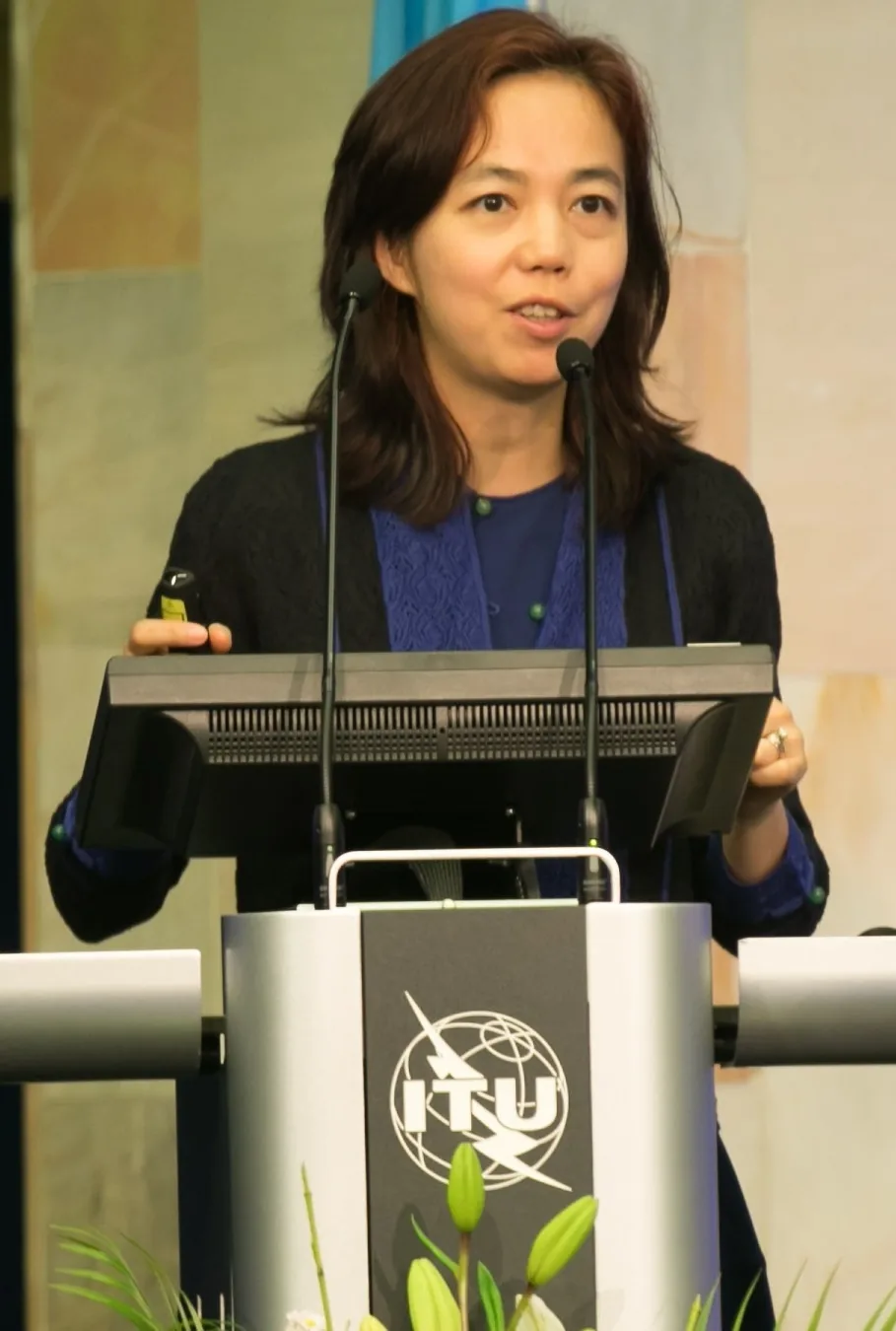
In 2006 the field had a learning algorithm (backpropagation) and an architecture (CNN), and yet computer vision had been treading water for ten years. Fei-Fei Li, then a fresh professor at Princeton, voiced a hypothesis that sounded almost heretical: the bottleneck is not the models but the data. Algorithms were tested on datasets with dozens of categories and thousands of images — whereas a child by the age of three “trains” on hundreds of millions of impressions. She therefore decided to map the visual world at a scale nobody had thought of until then: she built the ImageNet project (CVPR 2009) on the WordNet hierarchy of concepts and eventually filled it with more than 14 million manually verified images in more than 20 thousand categories. The annotation was only manageable thanks to the then-new Amazon Mechanical Turk platform — crowdsourcing at mass scale was an engineering feat in itself (and a precursor of today’s RLHF annotation pipelines).
Grant agencies rejected the project, colleagues advised her to do “proper science”. The turning point came thanks to the ILSVRC competition (from 2010, a subset: 1.2 million images, 1000 classes), which gave the field a common yardstick — and in 2012 AlexNet exploded on it. Here the thread of the story ties into a knot: Hinton’s algorithm, LeCun’s architecture and Fei-Fei Li’s data met gaming GPUs and launched the current era of AI. None of the three components would have sufficed alone; the benchmark also showed how brutally effective a shared, public and sufficiently hard metric is. (We write about how coding assistants are measured today and why it is harder than it looks in the article on benchmarks for coding assistants.)
Fei-Fei Li is often called the “godmother of AI” and her path continues consistently: she co-founded the Stanford Institute for Human-Centered AI (HAI) and the non-profit AI4ALL, wrote the autobiography The Worlds I See — and in 2024 founded the startup World Labs, which bets that the next frontier after language is spatial intelligence: models that understand and generate the 3D world. Its first product, Marble (November 2025), generates walkable 3D scenes from text or images, and in early 2026 the company raised a billion dollars for the vision. It is remarkable that the person who gave AI “eyes” through data is now trying the same with space — and that LeCun independently bet on world models too.
6. Ashish Vaswani and the Transformer team — attention instead of recurrence
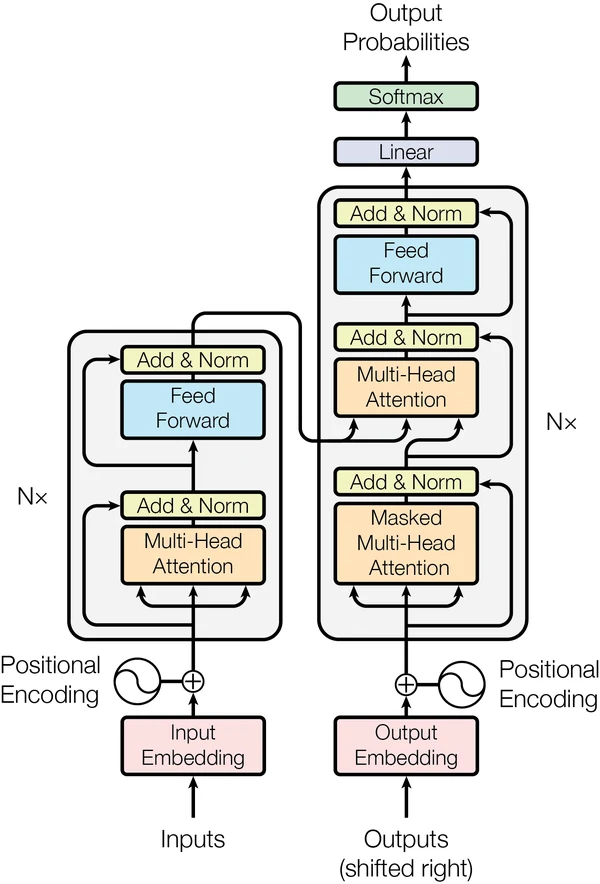
The only milestone on our timeline with not one name but eight: Ashish Vaswani, Noam Shazeer, Niki Parmar, Jakob Uszkoreit, Llion Jones, Aidan Gomez, Łukasz Kaiser and Illia Polosukhin. Their paper Attention Is All You Need (June 2017) is by a wide margin the most influential AI publication of the decade — the T in GPT is Transformer.
Context: sequences (text, speech) were until then processed by recurrent networks — an LSTM read a sentence token by token and accumulated meanings in a hidden state. This has two structural problems. First, sequentiality: step t can’t be computed before step t−1, so training can’t be parallelised along the length of the sequence — and GPUs, whose strength lies precisely in massive parallelism, sit idle. Second, path length: information between the first and last word of a sentence must pass through all intermediate steps; the gradient gets diluted along the way and long-distance relationships are learned poorly. The attention mechanism introduced in 2014 by Bahdanau, Cho and Bengio (Bengio again!) mitigated these problems — but only as an add-on to a recurrent network.
The Transformer’s radical step: throw out recurrence entirely and keep only attention. Each token is projected into three vectors — query, key and value — and the relationship between tokens is computed as the dot product of query and key (scaled and passed through softmax), which weights the values. All pairs at once, in a single matrix multiplication:
# jadro self-attention v pseudo-PyTorchi
# X: [delka_sekvence, d_model]
Q = X W_q; K = X W_k; V = X W_v
vahy = softmax(Q K.T / sqrt(d_k))   # [n, n] - kazdy token vs. kazdy token
vystup = vahy V                      # vazeny soucet hodnot
This solves both problems at once: the path between any two tokens has length 1 (no gradient dilution through intermediate steps) and the computation is one big matrix multiplication — exactly what GPUs and TPUs do best. Multi-head attention then lets the model track several types of relationships simultaneously (syntax, coreference, position…) and because attention itself has no notion of word order, positional encoding is added. The price is quadratic complexity O(n²) in sequence length — the reason why KV cache and long contexts are still being worked on today and why LLMs have problems like lost in the middle.
The original model, meanwhile, aimed only at machine translation (WMT 2014, BLEU 28.4 on EN→DE, training 3.5 days on eight GPUs). The breakthrough came when it turned out that the architecture scales almost perfectly: BERT (2018), GPT-2 (2019), GPT-3 (2020) are at their core still the same block, just bigger and with more data. Today the Transformer also powers vision models, image generation and AlphaFold. And the fates of the authors illustrate the gravity of that work: all eight left Google and are behind companies such as Cohere (Gomez), Sakana AI (Jones), Character.AI (Shazeer), Essential AI (Vaswani) or NEAR Protocol (Polosukhin); Kaiser is at OpenAI, Parmar at Anthropic. One paper, half of today’s AI ecosystem.

7. Demis Hassabis — from the game of Go to the Nobel Prize in Chemistry

Demis Hassabis’s CV looks like a prepared plan: a chess master in training (at 13 the second-highest-rated player in the world under 14), at seventeen co-author of the hit game Theme Park, then his own game studio, a PhD in cognitive neuroscience at UCL focused on memory and imagination — and in 2010 the founding of DeepMind with Shane Legg and Mustafa Suleyman, with the explicit mission “solve intelligence, and then use it to solve everything else”. Google bought the company in 2014 for hundreds of millions of dollars when it still had no product — just a demo in which a single network learned to play dozens of Atari games from nothing but pixels and the score (deep Q-network, published in Nature 2015 — the first major union of deep learning with reinforcement learning).
March 2016 became a world event: AlphaGo beat Lee Sedol, one of the best Go players in history, 4:1. Go was considered a goal a decade away — the search tree is orders of magnitude larger than in chess and there is no simple evaluation function. AlphaGo combined three components: a policy network (proposes promising moves), a value network (estimates who will win the position) and Monte Carlo tree search, which uses them to guide the search; it learned first from human games and then by playing against itself. The famous move 37 of the second game — a move a human would have played with a probability of 1 in 10,000 according to the policy network and which commentators at first considered a mistake — became the symbol of a machine that not only imitates but discovers. The successor AlphaGo Zero (2017) then dispensed with human data entirely: it started from random weights and, from the rules of the game alone, surpassed the level of the original system within a few days. A pure lesson in the power of self-play RL — and a harbinger of today’s trend in which the agentic behaviour of models is fine-tuned via reinforcement learning.
If Hassabis had stopped at games, it would be a great engineering story. But games were always just a benchmark for him. In 2020 AlphaFold2 at the CASP14 competition effectively solved the 50-year-old problem of predicting a protein’s 3D structure from its amino acid sequence: a median accuracy of around 90 GDT is comparable to experimental methods that cost months of work and money. Architecturally, incidentally, it is again attention — the Evoformer processes alignments of related sequences and a map of pairwise distances. DeepMind subsequently published with EMBL-EBI predicted structures for over 200 million proteins — practically all that science knows — and in October 2024 Hassabis and John Jumper received half of the Nobel Prize in Chemistry for it (the other half went to David Baker for the design of new proteins). Two Nobel Prizes for AI in one week of 2024 — Hinton’s in physics and this one in chemistry — are perhaps the clearest signal that AI has stopped measuring itself only against itself and started changing other sciences. Today, as CEO of Google DeepMind, Hassabis leads among other things the development of the Gemini models.
The thread that ties the story together
Let’s try reading those seven stops at once. Turing proved that computation is a universal medium and proposed learning as the path to intelligence. McCarthy gave the field a name, a language and a first paradigm — symbolic reasoning. Hinton (with Rumelhart, Williams and alongside Bengio) supplied the learning algorithm, LeCun showed that the architecture must match the structure of the data, and Fei-Fei Li demonstrated that without data at the right scale both are useless. When these three components met the power of gaming GPUs in 2012, AlexNet was born. The Transformer then removed the last obstacle to scaling — sequentiality — and Hassabis demonstrated that the same machine learning that wins games can produce scientific knowledge for which Nobel Prizes are awarded.
A pattern that repeats remarkably often: a breakthrough happens when an idea (often decades old), data at sufficient scale and hardware that can carry it meet. Backpropagation waited 26 years for its moment. Convolutional networks 23 years. Attention “only” three years. And the second half of the pattern: almost every one of those discoveries went against the current at the time of its creation — neural networks under a ban, ImageNet without grants, the bet on Go “a decade early”. The field’s consensus has been wrong in AI so often historically that it is healthy to read today’s confident predictions (in any direction) with reservation.
What to take away as a developer
- Read primary sources. Attention Is All You Need has 11 pages and you can read it in an evening; understanding the Q/K/V matrices then explains half of the operational properties of LLMs — from KV cache to the attention U-curve.
- Data is a product, not an appendix. Fei-Fei Li’s lesson applies to your RAG system or agent evaluation too: a carefully built dataset and metric often deliver more than swapping the model.
- Architecture = encoded assumptions. The CNN won because it matched the structure of images; the Transformer because it matched the structure of the hardware. When you design a system, ask what structure it matches.
- Scaling has structural causes, not magical ones. The Transformer doesn’t scale because it is “smarter” but because it removed sequential dependencies. Similar reasoning is useful for any distributed architecture.
- Old ideas come back. McCarthy’s symbolism lives on in tool calling and knowledge graphs, reinforcement learning from AlphaGo in the post-training of today’s models. Knowing history pays off — it saves dead ends.
Want to build on the shoulders of these giants, not just read?
In the AI Agent Developer course we go through the whole modern layer hands-on: from how the Transformer and LLMs work inside, through tool calling and RAG, to building your own agents. The basics of machine learning and LLMs are also covered by Artificial Intelligence for Programmers, Science and Data Analytics. And if you want to get hands-on with models on your own hardware, we have the GPU Lab for you.
Sources and further reading
- A. Turing: On Computable Numbers (1936) — the Turing machine and the limits of computability
- A. Turing: Computing Machinery and Intelligence (1950) — the imitation game and learning machines
- McCarthy, Minsky, Rochester, Shannon: A Proposal for the Dartmouth Summer Research Project on AI (1955)
- Rumelhart, Hinton, Williams: Learning representations by back-propagating errors (Nature, 1986)
- Krizhevsky, Sutskever, Hinton: ImageNet Classification with Deep CNNs (2012) — AlexNet
- LeCun et al.: Gradient-Based Learning Applied to Document Recognition (1998) — LeNet-5
- Deng, Dong, Socher, Li, Li, Fei-Fei: ImageNet: A Large-Scale Hierarchical Image Database (CVPR 2009)
- Vaswani et al.: Attention Is All You Need (2017)
- Jumper et al.: Highly accurate protein structure prediction with AlphaFold (Nature, 2021)
- ACM: Fathers of the Deep Learning Revolution Receive Turing Award (2019)
- Nobel Prize in Physics 2024 (Hopfield, Hinton) and in Chemistry 2024 (Baker, Hassabis, Jumper)
- Fei-Fei Li: The Worlds I See (2023) — autobiography on the creation of ImageNet
